Tariffs
A tariff is a pricing structure that is applied to units of usage The consumption of services, for example a subscriber using call minutes. for billing purposes. All subscriptions have a tariff. The tariff drives how a subscription A billing entity that incurs a charge. Examples include a network attached device whose usage you want to measure and charge for, or a monthly software subscription is connected to a network In the context of CMP, the infrastructure on which usage of registered customers will be measured – this could be a mobile phone network, broadband network or other non-telecommunications network. prior to usage being consumed. Selecting a tariff, via the network and service code, ensures the subscription is connected to the correct network and service.
In an offline charging implementation of CMP Converged Monetisation Platform. The MDS Global product that supports customer care and billing for digital service providers., the tariff controls the charges that a subscriber The end user of a network. incurs for both usage event records and non-usage events. A tariff comprises unit-based usage charges for the subscription service and can have services linked to it for which further charges can also be applied. These available service charges can be one-off charges, such as connection fees, or recurring charges, such as insurance. Tariffs can have a billing type of prepaid or postpaid. A postpaid tariff must have a full overage spend cap defined to help prevent bill shock for customers.
In an online charging implementation, usage event charges and usage-related discounts are driven by the Online Charging System (OCS).
When you configure a tariff, you can:
- Supply a unique alphanumeric ID and a meaningful descriptive name.
- Select a network type.
- Indicate the billing type - either prepaid or postpaid.
- If the billing type is postpaid, specify an overage full spend cap A service for customers that applies a limit to how much usage a customer can consume outside of their allowances or bolt-on extras, preventing spending over a certain amount..
- Choose the OCS rating In telecommunications, determining the cost of a particular call. Involving converting call-related data into an equivalent monetary value. plan.
- Specify the billing media, for example online billing, large print, braille, etc.
- Configure when the first and final bills will be sent, as well as bill frequency.
- Specify which terms and conditions apply to the tariff.
- Control termination charges based upon period of notice, termination fee days and maximum total termination fee.
- Control whether new subscribers can connect to the tariff.
- Provide explanatory text to help future users to understand the tariff.
- Select which day's pricing will apply to public holidays.
- Configure usage limits - daily, upper and lower - and the workflow event which is triggered if the daily limit is exceeded, for example a notification via text.
Tariff Links
Discount schemes, packages and price plans can be linked to tariffs. You can configure the following:
-
Tariff Packages
A CMP package is a collection of services and/or discounts that can be added to a subscription. Packages created in CMP must be linked to the required tariff to be picked when a tariff is selected. If a package and a tariff are not linked, the package cannot be selected. Services are added to the tariff package from the linked package; the service price can be amended when it is added to a tariff package. The added services are called tariff package services. Services that are not in the package cannot be added to the tariff package.
Note: Shared bolt-on
An addition to a subscriber's main plan or product; also sometimes called an add-on. packages cannot be linked to tariffs.Discounts are added to the tariff package from the linked package; the discount price cannot be amended when it is added to a tariff package. The added discounts are called tariff package discounts.
-
Tariff Services
Services are all chargeable and non-chargeable non-usage items in CMP. Services can be a one-off (connection fee) or recurring (line rental). Only one instance of a service can be active at any one time. Services can be global services, which can be added to any tariff, or a service that can only be applied to particular tariffs via a tariff package.
-
Tariff Discounts
Discount schemes reduce the price of services and call class groups by a percentage of the original amount or by a fixed value. Discount schemes do not alter the price of services or call class groups; instead a credit is added for the discounted amount. You can also configure a negative discount, which adds a surcharge to the subscriber.
-
Tariff Spend Caps
A spend cap
A limit on a subscriber's service. is a service for customers that applies a limit to how much usage a customer In the context of the Cloud Monetisation Platform, an individual or organisation who has signed an agreement to take goods and services from a service provider. A customer receives a bill associated with one or more subscriptions, and can be a single end user or a large company with many subscriptions assigned to one agreement. can consume outside of their allowances or bolt-on extras, preventing spending over a certain amount. Tariffs with a postpaid billing type must be linked with an overage full spend cap. For more information, see Spend Caps.
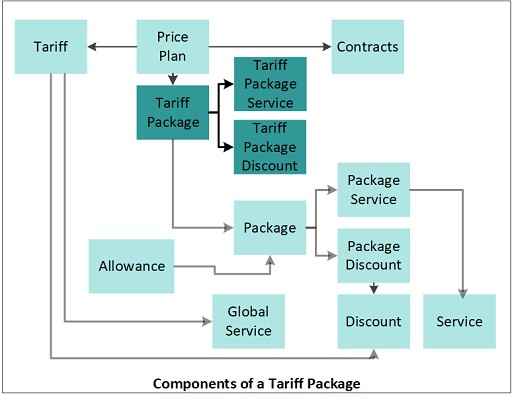
Add services and discounts to a tariff via a tariff package